Ahoy Mateys! Make your way around a rhythm pattern treasure map to find the pirate's treasure!
Students will love this bingo-style game! Each of the 26 sheets are different, but contain six of fourteen different rhythm patterns. The Grade 1 version includes 4-beat rhythm patterns using Ta, Ti-Ti and Shh.
The file also includes a blank map for other gameplay options! One example: print off the blank map and laminate. Students use dry erase markers to notate rhythms that are clapped.
This is a fun unit I have done with students in grades 3, 4 and 5. (For a printable copy of the lesson plan, click here)
Unit Plan: Weather Is Full of the Nicest Sounds Grade 3, 4 or 5
Objectives: Music Language & Performance Skills:
play a variety of instruments with increasing expressiveness and accuracy, demonstrating proper technique
demonstrate appropriate interpersonal skills for making music collectively
read, write and identify rhythmic and melodic patterns using invented and standard music notation
use invented music notation to represent sounds and/or sound stories
use and identify elements of musical expression
identify, describe and classify a wide variety of sounds from the natural and constructed environment
Creative Expression in Music
search for and discover ideas, themes, and/or motifs for music making through experimentation, improvisation, and/or play with music elements, concepts and techniques
identify, explore, and select ideas from a variety of sources as a starting point for music education
select, organize, and use, with increasing independence, a combination of sounds and/or musical ideas for composing and arranging musical pieces
explain own decisions about the selection and use of music elements, techniques, expressive devices, forms and principles of composition in own ongoing work
demonstrate a valuing of risk taking as a component of the creative process
collaborate with others to develop and extend musical ideas
make interpretive musical decisions, demonstrating understanding of a variety of ways in which expressive devices can be used
rehearse, revise and refine music to perform for others
make appropriate decisions as to whether own work is “finished”
share own musical ideas, compositions, and interpretations with others through performances, composition portfolios, and/or sound/video recordings
Understanding Music in Context
recognize that music is an art form, along with dance, drama, literary arts and visual arts
engage and/or interact appropriately as participants, audience members, and performers
Valuing Musical Experience
participate actively in music learning experiences
ask relevant questions and contribute to discussions in music learning experiences
describe and analyze own and others’ musical excerpts, works, and/or performances in terms of music concepts
demonstrate understanding that noticing details enhances own thinking about music, as well as appreciation, performance, and creation of music
reflect on, share, and explain personal responses evoked by various pieces of music and music-making experiences
respect and acknowledge that individuals may have different interpretations and preferences regarding musical works and experiences
demonstrate appreciation for a variety of music and music-making experiences
reflect on and describe own processes in performing and creating music, and use music vocabulary appropriately to describe what worked well, problems encountered and solutions found
Activate:
Have students close their eyes and listen to the recording of “Weather is Full of the Nicest Sounds” (by Musikgarten). Ask them to listen for the kinds of words used to describe weather sounds, and the instrument sounds used to represent these describing words. (If you are not able to access a recording of this, simply read the poem (or create your own recording with instruments!).
Discuss what was heard.
Ask students how they think instrument/performance decisions were made and what needed to be done in order to create the recording.
Discuss how we can use word art to make words look how they might sound or appear. Try the example “wiggle” on the board, writing wiggly letters to spell the word.
Give students other examples (eg. slide, fire, crash, bounce, shiny, etc.), and have students demonstrate a way of writing the words on the board. Allow more than one student to try the same word to demonstrate that one word can be written in many different ways. *Many students often write the word in plain text and then draw around it - encourage the students to let their lettering be the art.
Acquire
Allow students to choose a partner or work alone. Give each group a piece of paper with one of the adjectives from the poem written in the top corner. Depending on the class size, some groups may do more than one word.
Students draft ways of writing the word so that it looks the way it might sound. Play the recording again, so that students can listen for their words and hear what they sound like for inspiration.
Once they are ready, students can take a piece of white paper and create the word art with detail and colour.
Allow students to show their pictures to the class and describe why they chose to represent their word in their particular way.
Put all of the pictures on the board in order. Play the recording again, pointing to each word as it comes along.
As a class, brainstorm ideas of available pitched and non-pitched percussion instruments that could be used to represent each adjective.
Lay out the adjective pictures across the floor, placing the corresponding instrument (chosen by the class) in front of it.
Students each stand behind a word and play the corresponding instruments as the teacher or a student reads the poem.
Invite classroom teacher to watch performance. Video or audio record performance for students to watch/hear.
Apply
Brainstorm a list of sound adjectives.
Brainstorm other places, times or instances that have distinct sounds.
As a class, write a sound poem using the template (eg. “A Train Station is Full of the Nicest Sounds”).
Ask students to choose a topic and create their own “_____________ is Full of the Nicest Sounds” poem.
Students create their own adjectives for their topic, using a variety of resources for inspiration (books, audio recordings, videos, pictures, dictionaries, thesauruses, classmate/teacher ideas, etc.).
Students edit and revise poem with teacher and/or peer guidance to create a final product. Students may create word art for for each word if time allows.
Students choose instruments to represent each adjective.
Students create a visual representation of their poem (word art, ComicLife, pictorial music notation, etc.) for classmates to follow when performing.
Perform each poem with classmates playing designated instruments.
Following each performance, allow students to reflect on and assess the poem and choice of instruments.
Audio/Video record performances for students to view/hear.
Assess:
As a class, create a criteria that addresses the following:
appropriate instrument choices (Student can explain his/her choice and why it portrays its’ corresponding word)
appropriate word choices (Do they all fit the topic? Are they all adjectives/sound words?
Visual representation (How did students choose to represent their poems? Does the visual representation accurately portray the topic/sounds?)
Process/Finality (Did students revise & refine until the piece was finished?)
Following recording and viewing/listening, students self-assess their project based on the class-created criteria.
Weather is Full of the Nicest Sounds By Aileen Fisher
Weather is full of the nicest sounds: it sings and rustles and pings and pounds and hums and tinkles and strums and twangs and whishes and sprinkles and splishes and bangs and mumbles and grumbles and rumbles and flashes and crashes I wonder if thunder frightens a bee a mouse in her house, a bird in a tree a bear, or a hare, or a fish in the sea? Not me!
I can’t really say that this activity will be Quiet… I like to have fun and this activity is really a musical listening adventure. It is serious fun!
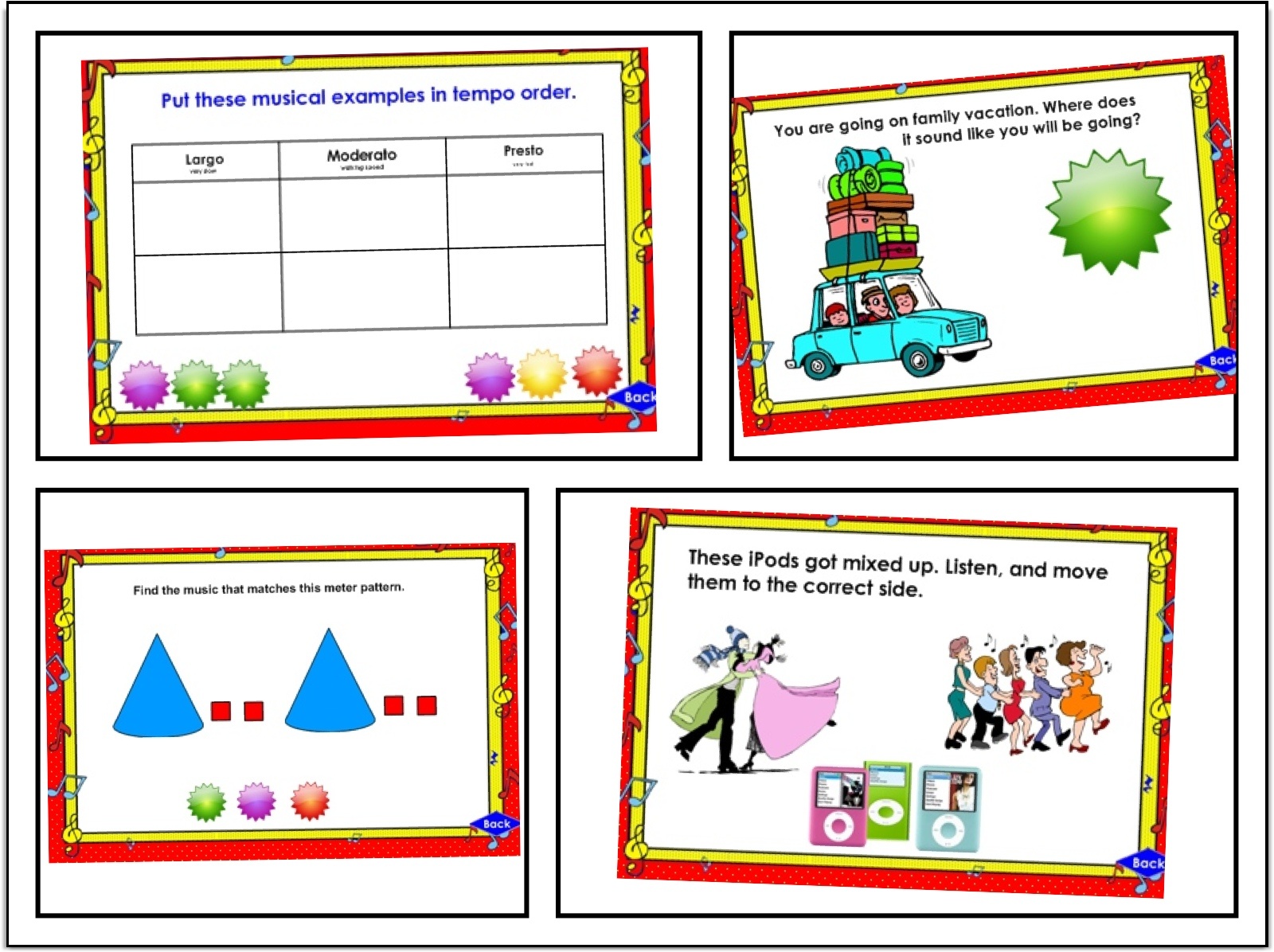
Linked: Each star-burst is linked to a different listening activity. There are enough linked pages for a class of 20 and several pages have multiple choices, so it is possible to accommodate even more children that way.
Here are a few of the listening activities in this file:
Listen for location music – Mexico
Listen for meter of 3
Listen for meter of 4
Arrange examples in tempo order: Largo- Moderato – Presto
Listen for music that matches food items
Listen for music written during grandparent’s time vs popular tunes
Listen and tell the story of the music - scary dream
Listen and identify music for “date night” – orchestra
Listen for music identifying commercials and TV shows
Listen and move to musical styles
Lesson flow: There are links to each page and back to the home page for seamless lesson flow. On most pages, there is a funny comment hidden in the choices. The kids love this and can’t wait to hit the jackpot! This would be a great lesson for a music sub… if you dare miss the fun!!